
Tired Torsion Springs
Torsion hardware that was fine in 1978 is simply tired now. On a cold morning a spring that has run out its cycle life finally lets go, and on the older houses here that is the single most common call we run.
Local garage door service · Johnson City, TN
Garage door repair and installation for Johnson City homes built mostly between 1958 and 2001, with a median build year around 1975 - covering springs, cables, rollers, openers, and off-track doors across Central, Pine Crest, Jonesborough, Oak Grove, and nearby areas through the region's cold-moderate winters.

Garage door services
From cable repair and off-track repair to opener installation, opener repair, maintenance, new door installation, and general garage door service, the lineup is built around Johnson City's 1958-2001 housing stock and the cold-moderate winters that wear original hardware fastest.


Common Johnson City garage door problems
Most of the houses we get called to went up between 1958 and 2001, with a median build year around 1975, so the doors and openers we see are either original equipment pushing fifty years old or a 1990s replacement now overdue for its own. Across roughly twenty named areas the stock skews heavily toward 1960s and 70s construction, and the jobs follow a very specific pattern.
Torsion hardware that was fine in 1978 is simply tired now. On a cold morning a spring that has run out its cycle life finally lets go, and on the older houses here that is the single most common call we run.
Many 1960s and 70s homes still run steel sectional doors on extension-spring setups mounted alongside the tracks. Decades of daily cycling stretch and fatigue that steel, so the door loses balance and strains everything downstream of it.
Plenty of garages here have a chain-drive opener that has never been touched since it was installed. The gears, travel settings, and logic boards drift and wear with age, and an opener straining against a tired door fails sooner than it should.
Original track brackets were screwed straight into framing that has shifted a little over the decades. Combined with worn, sagging rollers, that leaves doors binding, running rough, and sometimes jumping the track entirely.
Frayed or snapped lift cables are common across the area's older stock. They are often first noticed when a door sits unevenly on one side or drops suddenly on one corner as the worn strands finally give.
Clear repair guidance
We're not going to quote a number here, because a broken spring on a 16-foot double door and a bent track on a single-car door are two different jobs with two different parts lists, and guessing at a price before we have looked at the door does nobody any favors.
What we can tell you is what actually drives the cost: the part itself, how long it takes to source if it is an odd size left over from a 1980s build, and the labor to do the job right instead of just getting the door moving again.
On a lot of the older houses in this area the torsion hardware doesn't match what is sold off the shelf today, so a repair sometimes means adapting newer parts to older framing rather than a straight swap. That takes more time on site than a newer door would.
We would rather tell you that upfront than pad a quote to cover a surprise. With a median household income around $54,953 across roughly 42,230 households in the area, we know a repair bill isn't something people want to pay twice.
Local housing matters
Most of the homes we work on went up between 1958 and 2001, with the median build year landing around 1975 - which puts the bulk of our calls squarely in the 1960s-to-70s band, spread across roughly twenty named areas rather than one or two subdivisions.
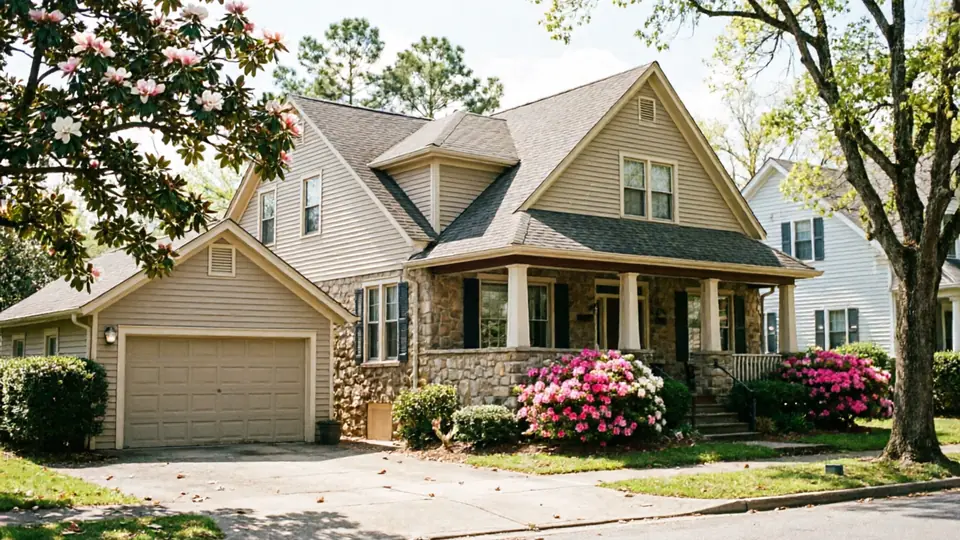
That matters for garage doors because the stock skews heavily toward that era: steel sectional doors, extension-spring setups, chain-drive openers, and torsion hardware that was standard decades ago. In Central, Pine Crest, Jonesborough, and Oak Grove you know the look - single-car and two-car attached garages with low headroom and original track brackets screwed straight into framing.
Out toward Gray, Elizabethton, Spurgeon, and Unicoi the same build era shows up with a bit more land around the house, but the same worn springs and sagging rollers come with it.
The framing has shifted a little over the decades, so brackets and tracks rarely sit as true as the day they went in, and that alone changes how a repair has to be approached on an older home.

Cold-moderate garage door wear
Johnson City sits in a cold-moderate climate, which matters more for garage doors than people expect. Steel panels contract in winter and expand in summer, and on the uninsulated doors common to 1960s and 70s houses that seasonal movement stresses panel seams, seals, and tracks a little more every year rather than failing all at once.
Steel panels contract in the cold and expand in the heat. On uninsulated doors that movement works on panel seams and weatherstripping every season, so seams loosen and gaps open gradually rather than from any single hard freeze.
Houses from the 1960s and 70s often predate standard insulated doors. Without that insulation the panels swing through a wider temperature range, and retrofitting insulation onto an old steel door is usually not worth the labor compared with replacing the panel.
We see it most on doors that face north or sit in a garage that never gets direct sun. The bottom seal hardens and cracks faster there, loses contact with the floor, and lets cold air and water work in under the door.
Tracks that aren't quite plumb bind up when the cold tightens the steel. A door that runs fine in summer can catch and strain in winter, which is wear that compounds quietly over seasons rather than anything dramatic.
What to expect
You tell us what the door is doing; before the truck leaves we ask enough to have a rough idea of what we are walking into, then on site we check the real failure points in order before quoting anything or touching a part.
You tell us what the door is doing - won't open, opens and stops, makes a bang and then nothing - and we ask enough questions to have a rough idea of what we are walking into before the truck leaves.
On site we check the obvious failure points first: springs, cables, rollers, the opener's travel settings, and track alignment. On older homes the track is often the real problem even when the symptom looks like an opener issue.
We will tell you straight whether it is a five-minute adjustment or a part that needs ordering. The quote comes before the work, not after the door is apart in your driveway.
We don't upsell a full door replacement to fix a bent roller bracket, and we don't pretend a patch job will hold if the spring system is actually at the end of its life. That call is made with you first.
Older Hardware May Need Ordered Parts
When a part is an odd size left over from a 1980s build, or the torsion hardware doesn't match what is sold off the shelf today, we may need to order it or adapt newer parts to the older framing - and we will tell you that up front.
Repair or replace?
A broken spring, cable, roller, or opener part doesn't automatically mean the whole door needs replacing. Replacement becomes the better value when the door and opener are both from the same original build and several systems are near the end of their life at once.
If the door is sound and it is one part that has gone, we are not going to talk you into a new unit you don't need. A targeted repair makes sense when the panels, tracks, and surrounding hardware are still serviceable.
Once a door and opener are both from the same original build - roughly the 1960s through the 1980s on most houses here - repair starts to lose its value, because fixing one part only delays the next failure on everything around it.
A new spring on an opener that is also failing, with a panel rusted through at the bottom, is money spent twice. When several systems are going together we say so instead of running up a bill on a door that needs replacing anyway.
With a median household income around $54,953 in the area, we know a repair isn't something people want to pay for twice. We look at the actual hardware and tell you honestly which side of the repair-or-replace line your door is on.
1950s–2000s garage door systems
Johnson City's 1958-to-2001 build range means garages combine steel sectional doors, extension-spring setups, chain-drive openers, and torsion hardware that no longer matches what is sold off the shelf - so no two older doors are quite the same repair.
The stock here is heavy with steel sectional doors from the 1960s and 70s. They are durable but uninsulated, and decades of seasonal expansion and contraction leave the panels and seams working loose over time.
Many older doors run extension springs mounted alongside the horizontal tracks rather than a torsion shaft over the opening. The hardware and the balancing are different, so the repair isn't interchangeable with a modern torsion door.
On a lot of these houses the torsion hardware doesn't match what is sold off the shelf today. A clean repair sometimes means adapting newer parts to older framing, which takes more time than a straight swap.
Openers wear out faster than the doors they lift, so many have been replaced once or twice while the door stayed original. We check the opener's age and condition on a separate timeline from the door hardware.
Built around Johnson City garage doors
With steel sectional doors, extension-spring and torsion setups, and openers swapped at different times often on the same street, the visible door, spring system, opener, and tracks may all be from different eras - so we inspect the system that is actually installed before matching any parts.
Spring type and size, door weight, cable condition, roller wear, track alignment, and opener hardware all get checked directly before anything is ordered, because what is on the house is often not what the catalog assumes.
On older homes the track is frequently the real issue even when the symptom looks like an opener fault. Brackets screwed into framing that has shifted over the decades pull tracks out of plumb and make a door bind.
When original hardware is scarce or mismatched, we adapt newer parts to the older framing rather than forcing a fit. It takes more time on site, and we would rather do it right than just get the door moving again.
When a part is an odd size left over from a 1980s build, we say so up front and lay out the real repair-versus-replace comparison before you decide, instead of discovering the problem with the door already apart.
Service areas
We are based in Johnson City and most of our calls stay close to home, across Central, Pine Crest, and the other named areas inside the city before we head out to the surrounding towns. Jonesborough and Oak Grove are regular stops, and we run jobs out toward Gray, Elizabethton, Spurgeon, and Unicoi, where the same 1958-to-2001 build era shows up with a bit more land around the house but the same worn springs and sagging rollers.
Farther out we still cover Bluff City, Colonial Heights, Hampton, Blountville, Hunter, Erwin, Fall Branch, Walnut Hill, Bristol, Bloomingdale, Butler, and Valley Forge as the route allows. The closer you are to Johnson City proper, the easier same-day scheduling is to land; the farther out we drive, the more we batch the route with a nearby call, so a little flexibility on timing helps.
From our Johnson City, TN base we run trucks across the surrounding towns rather than keeping a storefront in each one. Supported area pages cover Elizabethton, Erwin, Jonesborough, Oak Grove, and Unicoi - pick yours to see the local detail.
Questions
In a cold-moderate climate like ours, steel doors contract and the metal tightens around hardware that's already a little worn. On older, uninsulated doors common on 1960s-70s houses here, that seasonal movement is often what finally makes a weak spring or a loose track bracket fail, even though the real wear happened gradually over years.
It's possible, though less common than the door itself being original. Across this area the housing stock runs mostly 1958 to 2001 with a median around 1975, and many openers were replaced once or twice since. We check the opener's age and condition separately from the door hardware since they wear out on different timelines.
Yes, we work across the surrounding area including Central, Pine Crest, Jonesborough, Oak Grove, Gray, Elizabethton, Spurgeon, Unicoi, Bluff City, Colonial Heights, Hampton, Blountville, Hunter, Erwin, Fall Branch, Walnut Hill, Bristol, Bloomingdale, Butler, and Valley Forge.
If the door and opener are both from the original build and one part failing is really a sign the whole system is near the end of its life, repair usually just delays a bigger bill. We'll look at the actual hardware and tell you honestly which side of that line your door is on rather than guessing.
Ready when you are
Tell us what the door is doing and we'll help you figure out the fix across Johnson City.